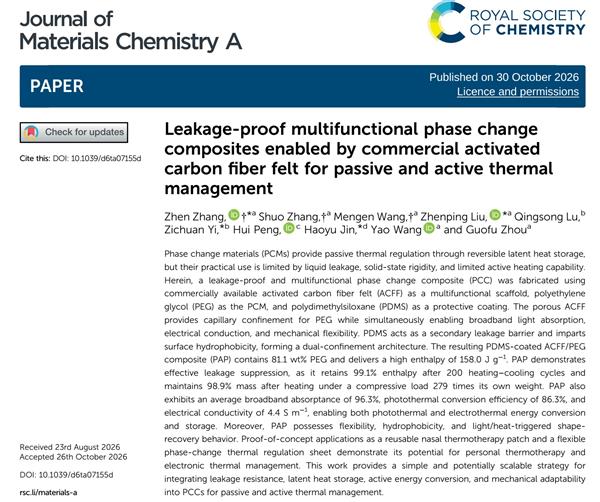
相变材料(PCM)能够在熔化时吸热、凝固时放热,为电子器件温度调控和人体局部保温提供了一种储热方式。然而,熔融泄漏、固态脆性以及光电能量转化能力不足,往往限制了PCM的使用。使用容易获得的材料和简便工艺,将防泄漏、高储热密度和主动加热结合起来是PCM领域的研究热点。华南师范大学张振等以商用活性炭纤维毡(ACFF)为多功能骨架,结合聚乙二醇(PEG)浸渍与聚二甲基硅氧烷(PDMS)封装,制备了柔性防泄漏相变复合材料PAP,即PDMS封装ACFF稳定的PEG。该材料可通过光照或通电实现能量输入,并利用相变过程储存和释放热量。相关论文以Leakage-proof multifunctional phase change composites enabled by commercial activated carbon fiber felt for passive and active thermal management为题发表在 Journal of Materials Chemistry A(JMCA)上。
张振课题组前期利用纤维素纳米晶(CNC)稳定的皮克林(Pickering)乳液,构筑了一系列具有防泄漏、稳定性好、焓值高、阻燃、光热转换、电热转化功能的PCM微胶囊(Small 2025, 21 (35), 2505575.Chemical Engineering Journal 2025, 511, 162036.Journal of Materials Chemistry A 2025, 13 (15), 10709-10722.International Journal of Biological Macromolecules 2025, 284, 138162.Science China Materials 2024, 67(10): 3225-3235. ACS Sustainable Chemistry & Engineering 2023, 11(38), 14255–14266.Chemical Engineering Journal 2022, 428, 131164. ACS Sustainable Chemistry & Engineering 2019, 7 (21), 17756-17767)。和PCM微胶囊相比,该研究制备的柔性防泄漏多功能相变复合材料PAP制备方法更简单便捷、成本更低、柔性好、稳定性更好、功能性更多,因此更具商业化应用前景。
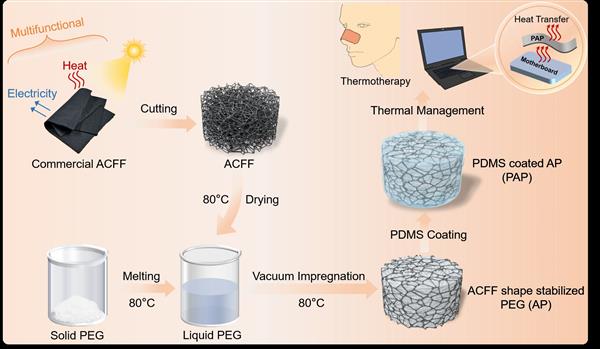
Figure 1. Schematic illustration of PAP fabrication with a high latent heat storage capacity, flexibility, and efficient photothermal and electrothermal conversion capabilities for passive and active thermal management demonstrations in personal thermotherapy and electronic devices. PAP的制备流程及其用于个体和电子器件热管理的设计示意图
商用炭毡兼顾储热支撑与光电加热
研究选用活性炭纤维毡(ACFF)、聚乙二醇(PEG)和聚二甲基硅氧烷(PDMS)构建复合材料。其中,PEG承担相变储热功能;ACFF提供多孔支撑、光吸收和导电通路;PDMS则在外侧形成柔性封装层。ACFF的实测比表面积为1544.7 m2/g,交织的纤维网络可容纳大量PEG,孔隙中的毛细作用有助于限制熔融PEG流动。连续碳骨架同时具有宽光谱吸收和导电能力,使支撑骨架也成为光热和焦耳热的来源。研究直接利用这一商品化骨架,省去了自行组装功能气凝胶及冻干的步骤。制备时,先通过真空辅助浸渍将熔融PEG引入ACFF,获得ACFF/PEG复合材料(AP),再涂覆并固化PDMS,得到最终材料PAP。内部多孔骨架与外部聚合物封装共同形成双重限域结构,将储热组分固定在材料内部。
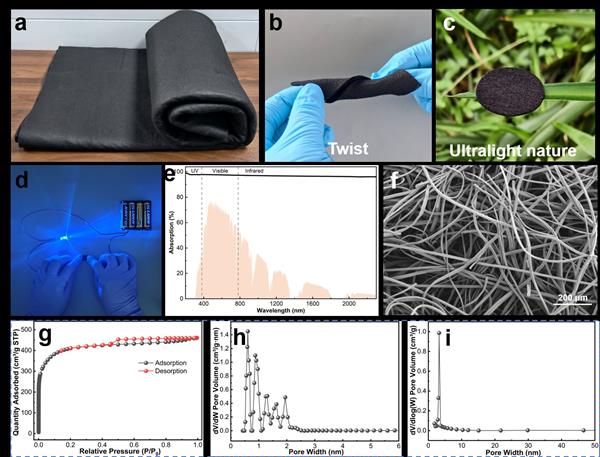
Figure 2. (a) Photograph of commercial ACFF. (b) Flexibility of ACFF. (c) Ultralight nature of ACFF. (d) Demonstration of the electrical conductivity of ACFF by lighting an LED bulb. (e) UV-Vis-NIR absorption spectrum of ACFF. (f) SEM image of ACFF. (g) N2 adsorption-desorption curves of ACFF. (h–i) Pore size distribution curves of ACFF.
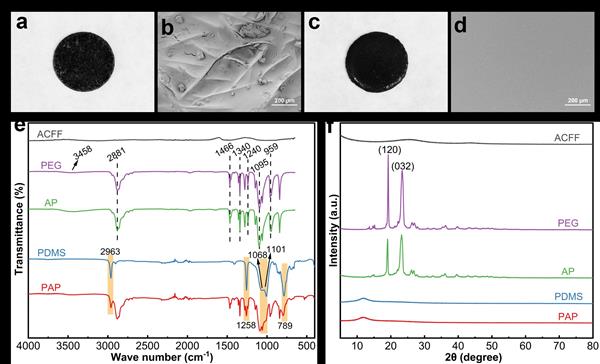
Figure 3. Photograph and the surface SEM image of (a, b) AP and (c, d) PAP, respectively. (e) FTIR spectra and (f) XRD patterns of ACFF, PEG, AP, PDMS and PAP.
高温与负载共同作用下有效抑制泄漏
定形并不意味着在受热和受压时都能避免泄漏。为考察封装效果,研究人员在90 ℃下开展了持续5 h的泄漏测试,并施加500 g负载。该负载约为PAP样品自重的279倍,对应压强约6.9 kPa。在相同的受热、负载条件下,未包覆PDMS的AP质量保留率降至69.9%,而PAP仍保持98.9%的初始质量,样品下方滤纸未见明显PEG渗漏痕迹。无外加负载时,PAP的质量保留率为99.2%。这一对照表明,外部PDMS封装能够补充多孔骨架的限域作用,在机械挤压下进一步抑制熔融PEG外逸。
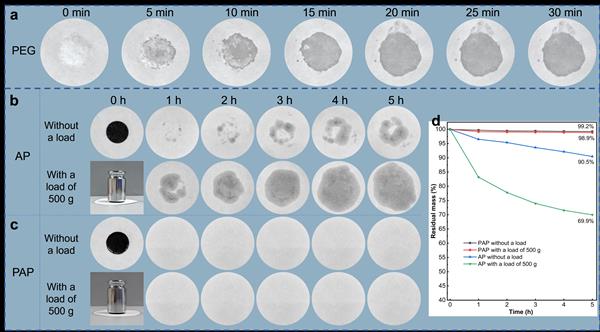
Figure 4. Digital images of (a) PEG, (b) AP and (c) PAP during leakage tests at 90℃ with and without a 500 g load. (d) The residual mass of the AP and PAP during the leakage tests. PEG、AP和PAP在90 ℃下的泄漏表现及AP和PAP的质量保留率
保持高相变焓并经受反复冷热循环
防泄漏封装需要兼顾储热组分的含量。AP的PEG负载量为90.6 wt%;加入PDMS后,PAP中PEG含量仍达到81.1 wt%。其熔融焓和结晶焓分别为155.6 J/g和160.4 J/g,平均相变焓为158.0 J/g,说明复合材料在引入支撑与封装组分后,仍保留了较高的潜热储存能力。在10–100 ℃范围内进行200次加热—冷却循环后,PAP的熔融焓和结晶焓保留率分别为99.2%和99.1%,DSC曲线形状及相变温度未见明显变化。内部限域与外部封装共同支持了反复熔融、结晶过程中的储热稳定性。
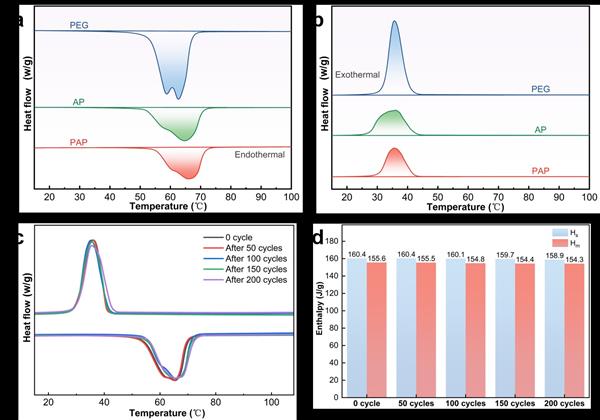
Figure 5. DSC curves during (a) melting and (b) cooling for PEG, AP, and PAP. (c) DSC curves and (d) the melting and solidification enthalpies of PAP after specific heating-cooling cycles. 复合材料的相变行为及PAP在200次冷热循环中的储热稳定性
光照与通电均可驱动相变储热
ACFF的碳骨架为材料提供了宽光谱吸收能力,透明PDMS封装则有助于保留光的进入通道。PAP在200–2300 nm波段的平均吸收率达到96.3%。在一个太阳光强(0.1 W/cm2)下,材料出现清晰的熔融吸热平台;撤去光照后,PEG结晶并逐步释放储存的潜热。按熔融过程的潜热储存量计算,PAP在该光强下的光热储能效率为86.3%。这一数值反映入射光能转化并储存为相变潜热的比例。在0.2 W/cm2下进行10次光照—冷却循环后,温度响应曲线基本保持一致。连续ACFF网络还赋予PAP约4.4 S/m的电导率。在论文的12 V测试条件下,PAP表面温度在30 s内升至52.3 ℃,随后出现与PEG熔融相对应的温度平台;停止供电后,冷却过程中再次出现放热平台。20次通断电循环中的响应保持稳定,表明该体系能够将焦耳加热与可逆相变储热结合起来。
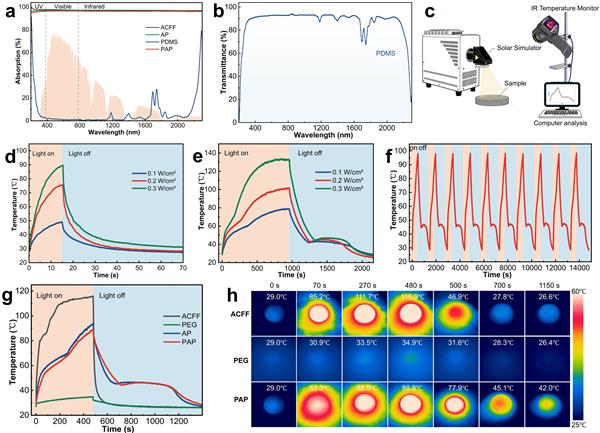
Figure 6. (a) UV–Vis–NIR absorption spectra of ACFF, AP, PDMS, and PAP. (b) UV–Vis–NIR transmittance spectrum of PDMS. (c) Schematic illustration of the photothermal conversion measurement setup. Temperature evolution curves of (d) ACFF and (e) PAP under different irradiation intensities. (f) Photothermal cycling curves of PAP during ten irradiation–cooling cycles at 0.2 W cm?2. (g) Photothermal conversion curves and (h) corresponding infrared thermal images of ACFF, PEG, AP, and PAP under irradiation at 0.2 W cm?2. PAP的光谱吸收、光热响应与光照循环稳定性
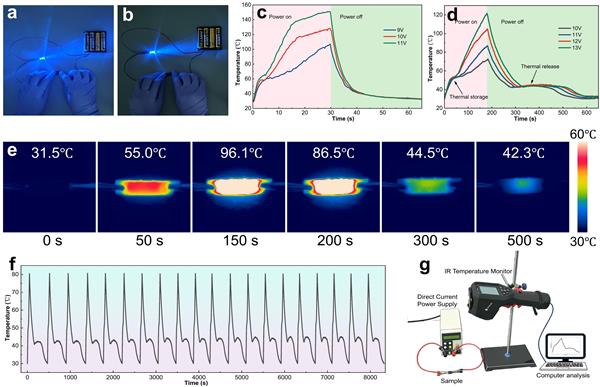
Figure 7. Photographs of electrical circuits in which conductive (a) ACFF and (b) PAP were used to light an LED. Temperature evolution curves of (c) ACFF and (d) PAP under different applied DC voltages. (e) Infrared thermal images of PAP under an applied voltage of 12 V. (f) Temperature evolution curves of PAP during 20 consecutive Joule heating cycles at 12 V. (g) Schematic illustration of the electrothermal conversion measurement setup. ACFF和PAP的导电与焦耳加热表现及PAP的通断电循环响应
柔性骨架支持贴合与形状恢复
PAP在室温下可弯折,在PEG熔融后进一步软化,能够贴合直角等不规则表面。其形状恢复也与PEG相变有关:加热软化后施加外力形成临时形状,冷却结晶后固定;再次加热或光照时,PEG熔融,ACFF/PDMS骨架中储存的弹性恢复力推动样品恢复原形。PDMS还使材料表面由易吸水转为疏水,初始水接触角达到114.7°。这些特性有助于材料适应曲面贴覆及接触水性液滴的使用场景。
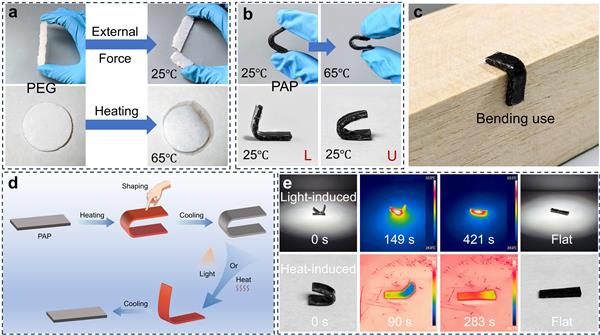
Figure 8. (a) Photographs of pristine PEG under external force at 25 °C (top) and under heating at 65 °C (bottom). (b) Photographs of PAP at 25 and 65 °C and in different fixed shapes. (c) Photograph of PAP conforming to a 90° right-angle surface. (d) Schematic illustration of the thermally induced shape-fixation and light-/heat-triggered shape-recovery mechanism of PAP. (e) Light- and heat-triggered shape-recovery processes of PAP. PAP的弯折贴合能力及热和光热触发的形状恢复行为
面向鼻部热敷与电子器件温度调控
研究将PAP制成7.0 cm × 4.0 cm的柔性鼻部热敷贴,演示了先储热、后释放的使用方式。在热充能对比测试中,12 V焦耳加热使贴片达到约65 ℃所需时间为98 s,快于所测试的沸水和烘箱加热方式。在完成热充能并断电后的冷却演示中,贴片表面处于40–45 ℃温度区间的时长约为17 min。PEG结晶时释放的潜热延缓了降温,展示了这一复合材料用于可重复使用个体热管理器件的潜力。在电子器件热管理演示中,研究人员将9.0 cm × 3.5 cm的PAP片贴覆于笔记本主板的发热元件表面。未贴覆时,被测元件裸露表面约33 s升至60 ℃,随后稳定在约74 ℃;贴覆后,红外相机记录的PAP外表面约30 min才升至60 ℃。这组表面温度结果展示了复合材料吸热储能、延缓外表面升温的作用。
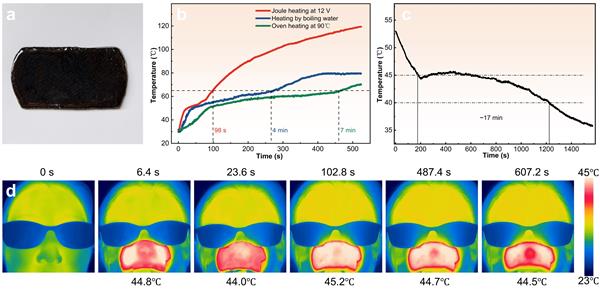
Figure 9. (a) Photograph of the flexible PAP nasal thermotherapy patch. (b) Temperature evolution curves of the PAP patch during thermal charging by oven heating, boiling-water heating, and Joule heating. (c) Temperature evolution of the electrically charged PAP patch during natural cooling. (d) Corresponding infrared thermal images of the nasal thermotherapy process. 柔性鼻部热敷贴的热充能方式及断电后的温度维持表现
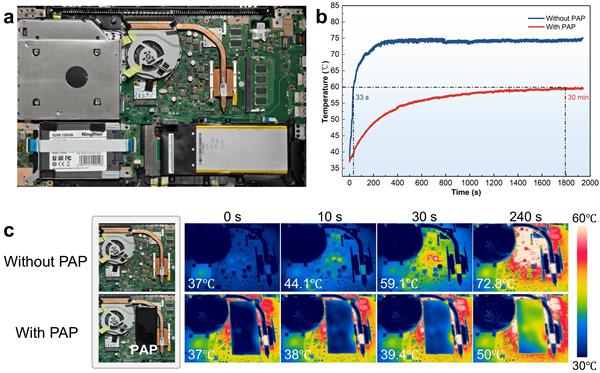
Figure 10. (a) Photograph of the laptop motherboard. (b) Surface temperature evolution curves of the selected electronic component with and without a PAP phase-change thermal regulation sheet (9.0 cm × 3.5 cm). (c) Corresponding infrared thermal images of the laptop motherboard without PAP (top) and with PAP (bottom). PAP用于笔记本主板的热调控演示及贴覆前后的表面温度响应
利用成熟商品材料简化多功能相变体系制备
这项研究将商用ACFF已有的多孔结构、光吸收和导电能力用于相变材料设计,通过PEG浸渍与PDMS封装,将高潜热储存、防泄漏和光电加热集成于同一柔性复合体系。高温负载测试与冷热循环结果为其性能提供了支撑,鼻部热敷和电子器件演示则连接了主动供热与被动温度缓冲两类需求。采用预制商品骨架的制备思路,也为进一步放大制备和器件开发提供了基础。
论文信息
Zhen Zhang#*,Shuo Zhang#, Mengen Wang#, Zhenping Liu*, Qingsong Lu, Zichuan Yi*, Hui Peng, Haoyu Jin*, Yao Wang, Guofu Zhou. Leakage-proof multifunctional phase change composites enabled by commercial activated carbon fiber felt for passive and active thermal management. Journal of Materials Chemistry A 2026. https://doi.org/10.1039/d6ta07155d